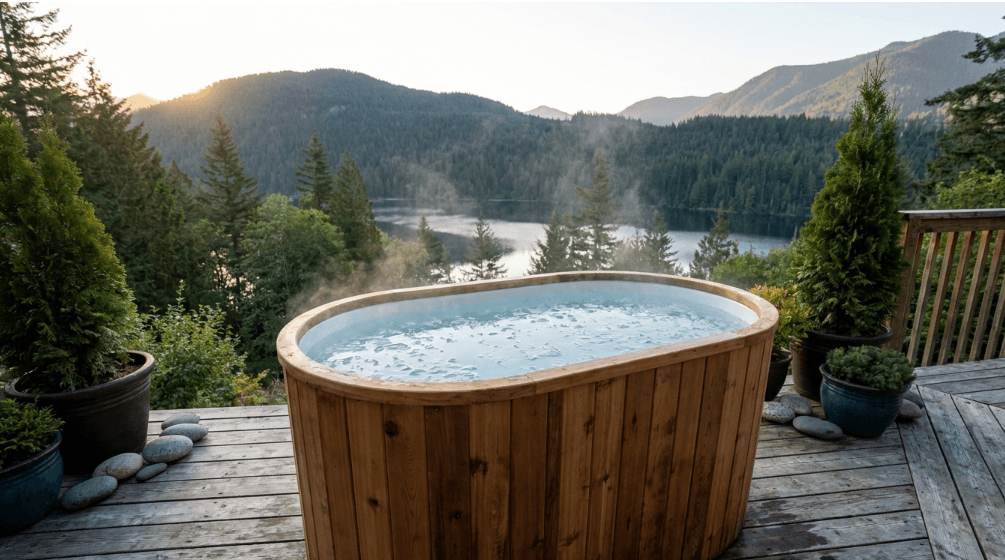
An ice-only cold plunge, a basic stock tank or tub filled with cold water and bagged ice, costs a few hundred dollars upfront and suits occasional use once or twice a week. A budget chiller-cooled tub costs more to start, commonly $1,800 to $3,500 for an entry-level unit, but removes the ongoing ice cost and effort, which pays off for anyone plunging three or more times weekly. The right pick comes down to how often you will actually use it and how much upfront cash you have to spend before that habit is proven out.
What’s the Real Difference Between the Two Approaches?
An ice-only setup relies on bagged or homemade ice added before each session to bring water down to a workable temperature, with no motor, compressor, or ongoing electrical draw. A chiller-cooled setup uses a small refrigeration unit plumbed to the tub that holds a set temperature automatically, typically somewhere in the 39 to 55 degree Fahrenheit range, with no ice needed once it is running. Both approaches, done correctly, get water cold enough to matter; they differ mainly in upfront cost, ongoing effort, and consistency.
Which One Actually Costs Less to Get Started?
Ice-only wins here by a wide margin. A basic galvanized stock tank or heavy-duty inflatable tub runs $150 to $500, with no electrical work and no installation beyond finding a level, drained spot for it. A budget chiller-cooled unit adds real cost on top of the tub itself, both for the chiller hardware and, in many cases, for an electrician to run a dedicated circuit. For someone still deciding whether a cold plunge habit will stick, starting with ice keeps the financial risk low while testing the routine for real.
Which One Costs Less Over a Full Year?
This is where the math often flips. Twenty to forty pounds of ice per session, several times a week, adds up to a real recurring cost, frequently $25 to $70 a month depending on local ice prices and how often the tub gets used, plus the ongoing physical effort of hauling and dumping bags. A budget chiller typically runs $15 to $35 a month in electricity and needs no manual ice runs once it is dialed in. For frequent users, the chiller’s higher starting cost is often offset within a year or two by what would otherwise go toward ice.
How Consistent Is Water Temperature With Each Approach?
A chiller holds its target temperature automatically within a degree or two, session after session, regardless of the weather that day. An ice bath’s actual temperature depends on how much ice went in, how long it has been sitting, and outdoor air temperature, so two sessions rarely land on exactly the same number without someone measuring carefully each time. A cheap floating thermometer narrows that gap considerably for a fraction of a chiller’s cost, though it still takes some manual adjustment to hit a consistent target compared to a chiller simply holding its set point.
Which Setup Fits an Actual Daily Routine Better?
A chiller-cooled tub is ready the moment you want it, with no prep beyond checking the display. An ice-only setup needs planning ahead, buying or freezing enough ice, filling the tub, and handling runoff and cleanup afterward each time. For someone plunging once or twice a week, that prep is a minor inconvenience. For anyone aiming at four or more sessions a week, the daily friction of the ice routine is a common reason the habit quietly drops off within a few months, which makes the chiller’s convenience worth more than its price tag suggests on paper.
So Which One Actually Fits a Tight Budget?
Start with ice if you are not yet sure a cold plunge routine will stick, or if you are only planning on using it once or twice a week; there is little financial risk in testing it that way first. Move to a budget chiller once the habit is proven and the weekly ice cost and hassle start feeling like a real tax on the routine, or if more than one person in the household plans to use the tub regularly. Comparing entry-level chiller packages against ice-only tub pricing at the SweatDecks catalog before committing gives a clearer sense of where that upgrade actually pays off for your own usage pattern.
Is There a Middle Option: a Small Chiller Plus Ice Top-Off?
Some budget-minded owners run a small, undersized chiller and top off with a bag or two of ice on the hottest days or for back-to-back sessions, rather than buying a chiller rated for worst-case demand. This hybrid approach lets you buy a smaller, cheaper chiller than a full-capacity unit would require, saving several hundred dollars upfront, while keeping a bag of ice on hand for the handful of days a year the chiller alone cannot keep up. It is not the most elegant setup, and it will not suit someone who wants zero manual involvement, but for a genuinely tight budget it captures most of a chiller’s convenience without paying for capacity that only matters a few weeks a year.
Does Either Approach Change What the Health Research Actually Supports?
No. The evidence behind cold-water immersion concerns water temperature and immersion duration, not the equipment used to reach them. A 2012 Cochrane review associated cold-water immersion with reduced perceived soreness after exercise, and a 2023 meta-analysis in Frontiers in Physiology found a similarly modest association with short-term recovery, neither distinguishing between chiller-cooled water and a well-executed ice bath. A broader 2025 systematic review and meta-analysis in PLoS One found the overall evidence mixed rather than uniformly positive. Whichever setup you choose, actually reaching and holding a cold temperature is what the research is built around, not which machine gets you there.
Frequently Asked Questions
Is an ice-only tub actually a good long-term option, or just a starter setup? It can be a legitimate long-term option for occasional users, once or twice a week, where the ongoing ice cost and effort stay manageable rather than becoming a daily chore.
How much can a small chiller actually save over buying ice every week? For someone plunging four or more times a week, monthly ice costs can approach or exceed a small chiller’s electricity draw within a year or two, though the chiller’s upfront cost is much higher to start.
Do budget chillers hold temperature as well as premium ones? Entry-level chillers generally hold a set temperature within a degree or two just like premium units; the main differences at the low end are usually noise level, smaller horsepower for a given tub size, and fewer features.
Can you start with ice and add a chiller later without buying a new tub? Many tubs can accept an add-on chiller later, but not all, so it is worth checking a specific tub’s chiller compatibility before buying an ice-only setup with a future upgrade in mind.
References
- Cold-water immersion (cryotherapy) for preventing and treating muscle soreness after exercise, Cochrane Database of Systematic Reviews, 2012
- Effects of cold water immersion after exercise on fatigue recovery and exercise performance: meta analysis, Frontiers in Physiology, 2023
- Effects of cold-water immersion on health and wellbeing: A systematic review and meta-analysis, PLoS One, 2025